Showing posts with label Korean recipe. Show all posts

Thursday, April 4, 2013

Donabe-steamed Soybean Sprout Namul


I make Korean-style dishes often at home, and "namul" (seasoned vegetable dish) is one of the most frequent and also easiest dishes I make. Among different kinds of namul dishes, I especially like soybean sprout namul.

 photo file_zps868b49df.jpg
With cute and handy donabe steam-roaster, "Tochinsai", I can make it really tasty, all in one donabe! I don't even need to boil water.

 photo a73ef5b2-efdd-40ef-8296-ab9afe0dd886_zpsc1ee1a67.jpg
First, spread soybean sprouts and julienned carrot on the grate of "Tochinsai". Cover with lid and put in microwave for about 2.5 minutes. With the effect of the heating grate and insulated body, they will cook evenly and nicely.

 photo file_zpsd45092c6.jpg
Mix the cooked soybean sprouts and carrot in the namul sauce in the lid of "Tochinsai".

 photo file_zpse106f578.jpg
Remove the grate from "Tochinsai" plate. Drain any liquid and wipe. Use the plate as a serving bowl. Yes, that's it!

Donabe-steamed Soybean Sprout and Carrot Namul

Ingredients: (for 3-4 servings as a side dish)
(namul sauce)
1 tablespoon white sesame seeds, roasted and ground
1/4 teaspoon grated garlic
a pinch of raw brown sugar
1/4 teaspoon light color soy sauce ("usukuchi shoyu")
1/4 teaspoon salt
1/4 teaspoon olive oil
1 tablespoon sesame oil
a pinch of thinly-sliced dry chili or red pepper flakes

6 oz (180 g)soybean sprouts
1.5 oz  (40 g) carrot, julienned

Procedure:
  1. In a small bowl, whisk together the ingredients for the namul sauce. Set aside.
  2. Set a grate (black side up) in the plate of "Tochinsai". Spread the soybean sprouts on the grate and add the carrot on top of the soybean sprouts.
  3. Cover with lid and cook in microwave (700-watt) for 2 minutes and 30 seconds.
  4. Uncover and turn the lid upside down. Once the vegetables are cooled down enough to handle by hand, transfer them into the lid and add the namul sauce. Mix by hand.
  5. Serve at a room temperature or cold.
Happy donabe life.

Monday, March 25, 2013

Donabe Pork Bulgogi


Here is my updated version of pork bulgogi, which is Korean-style spicy marinated pork and vegetables.

I use my homemade shio-koji gochujang paste in the marinade, so it gives really nice rich flavor to the dish. Also, my version of bulgogi is much less sweeter than conventional bulgogi. It's got all the natural flavors with a lot of vegetables. A real savory treat with the nice spicy kick.

With the tagine-style donabe, "Fukkura-san", the dish can be prepared in easy steps with the wonderful result.

 photo file_zps82007c7b.jpg
Marinade the pork belly slices in the special sauce.

 photo file_zpsf001fd48.jpg  photo file_zps9327adc0.jpg
Onion was sautéed and cabbage is added.

 photo file_zpsc4160a36.jpg  photo file_zps65903b21.jpg
Enoki mushrooms, bean sprouts, and marinated pork are added in layers.

 photo file_zpsb08968a2.jpg  photo file_zpsf54cd6eb.jpg
Cook for 8-10 minutes. Meanwhile, after 5 minutes or so, stir when the meat is more than half-way cooked.

 photo file_zpsdb198b72.jpg
Juicy pork bulgogi is ready!

Here's my recipe:

Kurobuta Pork Bulgogi

Ingredients: (4 servings)
(sauce marinade)
1 tablespoon gochujang (Korean fermented hot pepper paste)
2 tablespoons soy sauce
1 tablespoon Korean hot pepper powder (can be substituted with 1-2 teaspoons of chili flakes, although they are not quite same)
1/2 tablespoon sugar
1 tablespoon sake
1 tablespoon white sesame seeds
1 tablespoon grated ginger
1 clove garlic, grated
2 tablespoons grated apple 

1 pound (450 g) thinly-sliced Kurobuta pork belly or pork butt, cut into bite-size pieces
1 tablespoon sesame oil
1/2 medium-size onion, thinly sliced
3-4 leaves cabbage, cut into 3/4" (2 cm) wide strips
5 oz (150 g) enoki mushrooms
6 oz (180 g) bean sprouts 1 scallion, thinly-sliced diagonally
4 lemon wedges

Procedure:
  1. In a bowl, combine the ingredients for the sauce marinade and mix well. Add the pork and mix well by hand. Cover with a plastic and refrigerate for 15-30 minutes. 
  2. Heat the sesame oil in the skillet of "Fukkura-san" over medium-high heat for 3 minutes. 
  3. Turn down the heat to medium, and sauté the onion slices for 3-4 minutes or until they are slightly wilted. Add the cabbage, and stir for 30 seconds. 
  4. Add the enoki mushrooms and bean sprouts in layers. Place the marinated pork on top and spread over evenly. 
  5. Cover with lid and cook for 8-10 minutes or until the meat is cooked through. Meanwhile, check the doneness and stir 1-2 times after 5 minutes. 
  6. Turn off the heat and let it rest for 3-5 minutes. 
  7. Uncover and garnish with the sliced scallion. To serve, divide into individual bowls and squeeze the lemon.
Happy donabe life.

Thursday, March 21, 2013

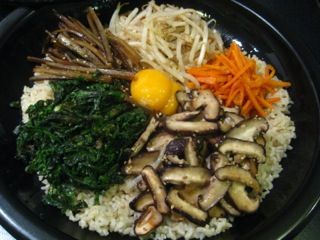
Sizzling donabe vegetable bibimbap ("sanchae bibimbap")


When we have dinner guests at home, we sometimes makes donabe bibimbap, and it's always a big hit. We cook the rice in the double-lid donabe rice cooker, "Kamado-san", and assemble the rice and toppings in the tagine-style donabe, "Fukkura-san", for a nice sizzling effect. People often fight for the crusty part of the rice!

For this dish, I like to make with brown rice. I partially polish the whole brown rice at home with my home rice polisher, so that the brown rice can cook just like white rice. But, if you don't  have a home polisher, you can find partially-polished brown rice at Japanese market, or you can also make whole grain brown rice...it's always gorgeous.
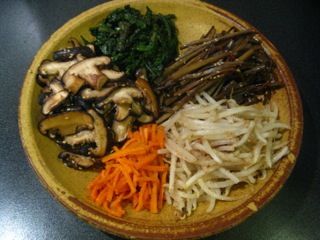
 photo file_zpsf489a4d7.jpg
Vegetable "namul" toppings are prepared separately.
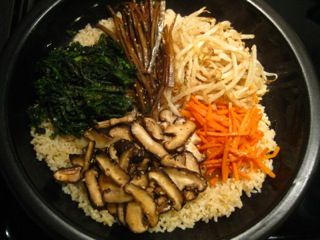
 photo file_zps0993c168.jpg  photo file_zps46e4a9b7.jpg
Cooked rice is transferred to "Fukkura-san", and topped with the vegetable "namul" toppings. Once the rice starts sizzling and the crust is made in the bottom, egg yolks are placed in the center and ready to be presented at the table.
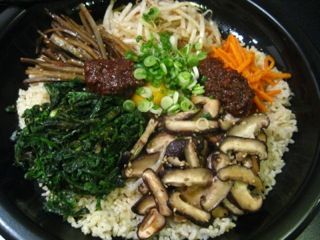
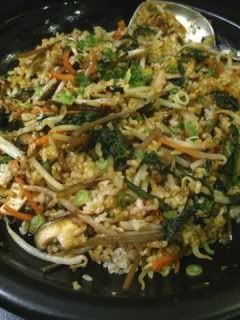
 photo file_zpsb5f26ff9.jpg  photo file_zpsf41b39ac.jpg
Gochujang paste and sliced scallion are added and everything is mixed together before being served into individual bowls.

Here's the update recipe of my "Sanchae Bibimbap" or Korean-style vegetable mixed rice.

Sizzling Korean-style vegetable mixed rice ("Sanchae Bibimbap")

Ingredients: (5 servings)
2 rice-cups (360 ml) short grain rice
1.5 cups plus 2 tablespoons (400 ml) water

("namul" dressing)
1.5 tablespoons toasted white sesame seeds, ground
1 small clove garlic, grated
1/4 teaspoon raw brown sugar
1/4 teaspoon light color soy sauce ("usukuchi shoyu")
1/4 teaspoon salt
1 1/2 tablespoons sesame oil
1/2 tablespoon olive oil
1 dry red chili pepper, thinly sliced into rings or 1/2 teaspoon red pepper flakes

6 oz (180 g) soybean sprouts or mung bean sprouts
6 oz (180 g) chrysanthemum leaves ("shungiku") or spinach
3 oz (90 g) carrot, julienned

1 tablespoon olive oil
4 oz (120 g) burdock root ("gobo"), julienned
1 tablespoon sake
1 tablespoon mirin
1 tablespoon soy sauce
1 teaspoon white sesame seeds

1 tablespoon olive oil
6 medium-size shiitake mushrooms, thinly sliced
1 tablespoon sake
a pinch of salt
1 teaspoon white sesame seeds

1 tablespoon sesame oil
2 egg yolks
1 scallion, thinly sliced crosswise
3-5 tablespoons Korean hot bean paste ("gochujang")

Procedure:
  1. In "Kamado-san", combine the rice and water, and cook according to the basic plain rice instructions.
  2. Meanwhile, prepare the "namul" (vegetable salad) toppings. In a small bowl, whisk together the ingredients for the "namul" dressing. Set aside.
  3. (Bean sprout "namul") Blanch the bean sprouts in boiling water for 10 seconds. Drain well. Mix with 1 tablespoon "namul" dressing. Set aside.
  4. (shungiku "namul") Blanch the chrysanthemum leaves in boiling water (salted) until wilted (5-10 seconds). Drain and rinse in cold water. Gently squeeze out the excess moisture and cut into 2" (5 cm) long. Mix with 1 tablespoon "namul" dressing. Set aside.
  5. (carrot "namul") Blanch the carrot in boiling water for 45-60 seconds. Drain and pat dry. Mix with 1/2 tablespoon "namul" dressing. Set aside.
  6. (gobo "namul") In a saute pan, heat 1 tablespoon olive oil and sauté the burdock root over medium heat for a few minutes.
  7. Add the sake, mirin, and soy sauce. Cover again and cook until the burdock root is tender and the liquid is reduced to almost nothing (10-15 minutes). Meanwhile, stir a few times.
  8. Turn off the heat.  Add the sesame seeds and stir. Transfer to a plate and set aside.
  9. (Shiitake "namul") Wipe the sauté pan. Heat 1 tablespoon olive oil and sauté the shiitake mushrooms over medium heat for until they are soft (3-4 minutes). Add the sake and continue to sauté until the mushrooms are cooked through.
  10. Add a pinch of salt and the sesame seeds. Stir again. Turn off the heat and transfer to a plate and set aside.
  11. To assemble, Heat 1 tablespoon sesame oil in the skillet of "Fukkura-san" over medium-high heat for 3 minutes. Make sure to coat the oil evenly over the entire surface of the skillet.
  12. Turn the heat down to medium, and add the cooked rice from "step 1". Spread evenly to the inner edge of the skillet. Add all the "namul" vegetables one by one and spread evenly over the rice.
  13. Cover with lid and cook for 4-5 minutes or until the the rice is sizzling. (If you are not sure of the doneness, you can open and carefully check the bottom side of the rice by using a spoon to make sure the bottom is nicely browned.) Turn off the heat and let it stand for 3-5 minutes.
  14. Uncover, place 2 egg yolks in the center. Add the scallion and 3 tablespoons of gochujang and mix well with a large spoon. Add more gochujang if you like and mix again. Serve immediately.
Happy donabe life.

Wednesday, May 9, 2012

Donabe Steam-fry Shio-koji Dak Kalbi (Korean-style spicy chicken)


Since my recent trip to Korea, I've been making more Korean-style dishes lately...with my donabe!
Especially because I brought back a jar of premium-quality kochujang (spicy bean paste) from Seoul, I wanted to make something which I can really enjoy the flavor of it the other night.

So, I decided to make Dak Galbi, Naoko-style.  Dak Galbi is a spicy chicken dish which is very popular in Korea.  There are even restaurants which specialize in Dak Galbi in Korea.  I made the dish with my Tagine-style Donabe, "Fukkura-san"...perfect donabe for this dish!

Photobucket
First, make layers of ingredients in the order of 1T sesame oil, 1/2 onion (sliced), 6 oz king oyster mushrooms (sliced - I sun-dried them for a day, but you can use fresh kind, too), and 10 oz chicken thighs (boneless and skinless, marinated in 1T shio-koji for a few hours - you can substitute shio-koji with 1/2 tsp sea salt).  Drizzle 1T sake and cover with lid (filled in water for 5 minutes and drained bofore use - the lid absorbs moisture and gives a nice steam-effect during cooking) and bring over medium-heat.  Cook for 5 minutes.

Photobucket Photobucket
Uncover and pour Dak Galbi sauce (mix together 1.5T kochujang, 1T sake, 1tsp honey, 1 tsp soy sauce, 1/2T grated ginger, 1tsp grated garlic, and 3T water).  Add a few leaves of cabbage (tear by hands).  Cover again and cook for 8-10 minutes or until everything is cooked through.  Meanwhile, uncover and stir a couple of times.

Photobucket Photobucket
Uncover again and add a good handful of crysanthemum leaves and stir.  Bring the donabe to the table and serve.

The taste was super good!  The complex flavor of the spices lingered on palate and made me want more and more.  Because it was cooked in donabe, the texture was really juicy and succulent.  Delicious.

Happy donabe life.

Saturday, December 10, 2011

Korean sesame leaves in soy marinade


This is one of my favorite items in typical Korean banchan (small side dishes). So, I decided to make my own. Sesame leaves ("kkaennip") have very distinctive aroma, which I really like. Fresh sesame leaves are much tougher than Japanese shiso leaves, but once they are marinated, they become soft and very nice.

Photobucket
First, make yangnyum sauce. Combine 3T sake (boiled once), 2T honey, 3T water, 6T soy sauce, 2tsp salted baby shrimp, 1.5T ground red chili, 1T roasted white sesame seeds, 1 small knob ginger (grated), 1 clove garlic (grated), 2 scallions (minced), and 1.5T sesame oil.

Photobucket
Sesame leaves are rinsed and pat dry. Then just submerge them in yangnyum one by one. In about 1 hour, they are ready.

Photobucket
These are great on its own, or I also love it with rice (I wrap rice in a piece of sesame leaf)! For any leftover marinade after eating all the leaves, I use it for making stir-fry noodles with it and it's really nice, too.


Friday, December 9, 2011

Warm Tofu and Mushroom "Namul" Salad


With my semi-dry mushrooms...
I made very easy salad with tofu and some greens.

Photobucket
Just set the mixed mushrooms and a piece of tofu, with a splash of 2T of sake, in a microwavable donabe steam-roaster, "Tochinsai" (without a grate). Cover and cook for 4.5 minutes (700-watt). This microwavable donabe is really amazing. You wouldn't believe it's cooked in microwave. Tofu comes out so fluffy and mushrooms are perfectly aromatic.

Meanwhile, to make the "namul" style dressing, combine 1T sesame seeds (roasted and ground), 1 small clove garlic (grated), a pinch of brown sugar, a pinch of salt, 1/8 tsp soy sauce, 1t olive oil, 1T sesame oil, and a pinch of thinly-sliced dry red chili.

Photobucket
To finish, pour the dressing over the tofu & mushrooms, and mix by a large spoon by breaking the tofu. Add some minari (dropwort - you can substitute with watercress or other green of your choice) leaves and toss again. That's it. You cook, mix, and serve in just one Tochinsai. So easy. And, it's so tasty.

Happy donabe life.

Saturday, December 3, 2011

Donabe hot pot...Miso Kimchi Jjigae


With my homemade kimchi, I was looking forward to make a hot pot dish. Kimchi and miso make good flavor combination, so I made Miso Kimchi Jjigae (Korean-style stew) with tons of my home-dried mushrooms and some leftover ingredients from the fridge.


Photobucket Photobucket
For the broth, I combined 3C water, a couple of dashi kombu (dry kelp) pieces (2" x 2"), and 1/3C sake with some sun-dried mushrooms and sliced abura-age. Since I had a couple of leftover pieces of donabe-smoked chicken drummets, I sliced off the meat and added the remaining bones to the water to enhance the broth flavors! Once the broth started simmering, I let it continue to simmer for about 5 minutes, then added 2.5T miso and 4 oz homemade kimchi and simmered further.

Photobucket Photobucket
Chicken bones were removed and other ingredients - some tofu, meat from donabe-smoked chicken drummets and gindara (black cod) were added and simmered until everything was cooked through.

Photobucket Photobucket
At the end, some chopped minari (dropwort) leaves were added, and the dish was ready. My homemade kimchi jjigae with leftover ingredients was fantastic! Wow...the broth was so deep and also the donabe smoked chicken added the extra depth in flavors.

Photobucket
After the hot pot, my homemade rum vanilla & cranberry swirl ice cream it another spot.

Happy donabe life.

Friday, December 2, 2011

Fresh Homemade Kimchi


I have probably mentioned this many times, but unfortunately I hate pickles in general. I wish I liked them. And, obviously, Korean kimchi is one of them. But, I discovered in my last trips to Seoul that I can handle freshly-made kimchi, or I even really liked some of them! I still cannot stand aged (with strong fermented flavor) kind, but if it's only the first or second day since it's prepared, I'm good. And, I really enjoyed learning how to make authentic kimchi in my last visit in Seoul.

So, here's my napa cabbage kimchi...which I enjoy eating on the first day it's made. When it's a little older, I can use it for making kimchi jjigae (kimchi hot pot) with donabe.


Photobucket Photobucket
For napa cabbage (medium-size), I cut it in half and soaked in salt water (1C salt was dissolved in about 2L water) overnight. Then, it was drained and rinsed throughly for 3-4 times.


Photobucket Photobucket
After rinsing the napa cabbage and lightly pressed to drain more water, it was sun-dried for a day. My happy napa cabbage enjoyed sun-bathing with my mushrooms (which are for other purposes).


Photobucket Photobucket Photobucket Photobucket
To make yangnyum paste (to mix with napa cabbage), I got anchovy sauce (1T), red chili pepper flakes (3-4T), salted baby shrimp (2.5T, then minced), honey (1/2T), ginger (1 knob, grated), garlic (1 clove, grated), apple (1/2 medium-small, grated), baby scallion (2-3, cut into 2" length), minari (dropwort, several stems, cut into 2" length), daikon (3 oz, cut into 2"-long thin match-sticks), sesame seeds (1T), and brown sugar (1 tsp). Baby shrimps are very salty, so I made sure to drain the liquid well before mincing them.


Photobucket Photobucket
For aging kimchi, you rub the yangnyum paste between the leaves of half napa-cabbage. But, since I am making it for eating soon, I already sliced the napa cabbage and simply tossed them in the paste.


Photobucket
My homemade kimchi is ready! It's so tasty...homemade is the best way.